Talking about overspending is one of the hardest conversations couples face — and one of the most avoided. A ₹15,000 shopping spree had brought one couple I worked with to the brink of separation. Seven years together. They’d survived long-distance, career changes, and family drama. And yet there they sat — arms crossed, avoiding eye contact — undone not by the money itself, but by what it meant.
“It’s not about the money,” she whispered, tears streaming down her face. “It’s that he made me feel like a child. Like I couldn’t be trusted.”
And there it was — the truth every relationship expert knows: money fights are never really about money.
Table of Contents
Why Talking About Overspending Costs More Than Money
“Financial disagreements are the number one predictor of divorce — more than arguments about sex, in-laws, or household chores.”
—Kansas State University Research
A landmark study from Kansas State University found that couples who argue about money early in their relationship are more likely to divorce — regardless of their income or debt levels. But what that research doesn’t capture is the emotional toll: the shame, the resentment, the feeling of being controlled or dismissed, the slow erosion of trust that happens when these conversations go badly.
After seeing many couples, I can tell you: it’s not overspending that kills relationships. It’s how we talk about overspending.
The Real Reason Talking About Overspending Goes Wrong
When your partner overspends, your nervous system enters threat mode. You’re thinking about your future, your security, your shared goals slipping away. Your brain interprets this as danger — and you respond accordingly, with criticism, blame, and character attacks.
“You’re so irresponsible!” “You have no self-control!” “Why can’t you just stick to a budget?”
These statements, while born from genuine fear and stress, trigger your partner’s defensive response. They feel attacked, shamed, and misunderstood. And when we feel attacked, we don’t become cooperative — we become defensive, resentful, or we withdraw entirely.
Relationship researcher Dr. John Gottman calls this “criticism” — one of the four communication patterns that predict relationship failure. Money conversations are particularly vulnerable to this pattern.
How to Start Talking About Overspending the Right Way
Let’s walk through the scenario I’ve come across countless times. Your partner has spent ₹15,000 on clothes. You’re trying to save ₹30,000 monthly for a home down payment. You’re frustrated, anxious, and yes — angry.
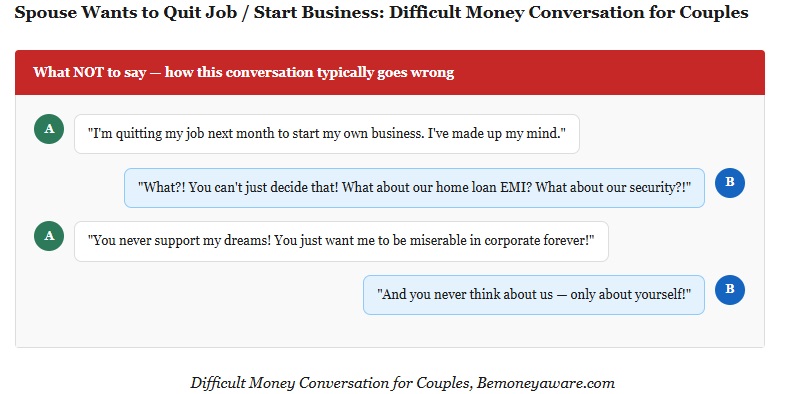
What NOT to Say When Talking About Overspending
This approach attacks the person, not the problem:
- Uses “you” language — immediately accusatory
- Makes character attacks (“no self-control”)
- Uses absolutes (“again,” “just wasting”)
- Creates shame instead of understanding
- Offers no path forward
Result? Your partner shuts down, gets defensive, or fights back. The real issue never gets addressed. The pattern continues.
What TO Say When Talking About Overspending
This is the real issue — not lack of self-control, not disrespect for shared goals. Just a feeling of restriction and deprivation. And once you understand the real issue, you can build a real solution.
Notice what’s different here:
- Non-threatening opening: “Can we talk?” — not “We need to discuss your problem”
- Factual statement: “We went ₹10,000 over” — not “You wasted ₹10,000”
- “I” statements: “I’m feeling stressed” — not “You’re making me stressed”
- Shared goals: “our home down payment” — not “my savings plan you’re ruining”
- Curiosity over criticism: “What’s happening?” — not “What’s wrong with you?”
4 Pillars for Talking About Overspending Constructively
4 Pillars for Talking About
Overspending Constructively
Your partner isn’t the enemy — the budget challenge is. Use “we” language and frame it as a problem you’re solving together, not a flaw you’re fixing in them.
“What’s happening?” is infinitely more productive than “What were you thinking?” Genuine curiosity opens doors. Judgment slams them shut.
“I understand the temptation” doesn’t mean you agree with the behavior. It means you see your partner’s humanity — and that validation is what makes the conversation move forward.
Shame doesn’t change behavior — it drives it underground. Good systems (automated savings, personal allowances, check-in thresholds) reduce friction and create lasting success.
Beyond Overspending: Other Money Conversations to Master
Once you’ve learned this framework for talking about overspending, you can apply the same approach to every financial conversation couples face:
- Differing risk tolerances with investments
- Supporting aging parents financially — especially relevant in Indian joint families
- Career changes that affect household income
- Spending on children’s education or activities
- Major purchases like cars or vacations
- Navigating financial obligations to extended family
The pattern is always the same: facts before feelings, curiosity before criticism, solutions before shame.
“It’s not overspending that kills relationships. It’s how we talk about overspending.”
—Difficult Money Conversations, BeMoneyAware
Frequently Asked Questions
Why is talking about overspending so difficult in relationships?
How do I bring up overspending without starting a fight?
Can money problems really end a marriage in India?
What is a personal allowance and how does it stop overspending fights?
What are the biggest financial communication mistakes couples make in India?
Have Money Conversations the Right Way
Download the free Money Dates Guide — it includes a full guided conversation with the safety plan template, metrics worksheet, and exit criteria framework built for Indian couples.
Take the Money Compatibility Quiz
Download the Free Money Dates Guide
Instagram Channel for Income Tax
Next: Episode 7 — Dealing With Wedding or Festival Debt Together
All Episodes in This Series
- When Your Partner OverSpends← You are here
- When Supporting Parents Is Straining Your Marriage
- When You Discover Secret Debt or Hidden Spending
- When You Disagree on When to Have Children
- When One of You Earns Significantly More
- When One Partner Wants to Quit and Start a Business
- Dealing With Wedding or Festival Debt Together
What money conversation have you been avoiding?
Share this article with your partner as a starting point — sometimes the easiest way to open the conversation is to read something together.