As traders, the Forex Economic Calendar is one of your best tools. You’ll only need a minute or less within a day, but that period is important if you want to become a profitable trader.
Table of Contents
What Is an Economic Calendar?
An economic calendar shows the planned data releases or news events connected with the economy and financial markets. These will include interest rate decisions, non-farm payroll numbers, and GDP. There are wide arrays of these economic data releases. These events are listed on the Forex Economic Calendar alongside with the planned time of release as shown in the image below.
Next, each event is graded, depending on which calendar site you use.
- Minor events will likely to have a minimal market impact are marketed as “Low” (low impact) or don’t have any special markings.
- Events that may have a market impact are marked as “Medium” and usually have a yellow star or dot beside the event. Yellow states some caution is warranted at this time.
- Red dots/stars indicate a significant data/news release which likely to move the market in a drastic way.
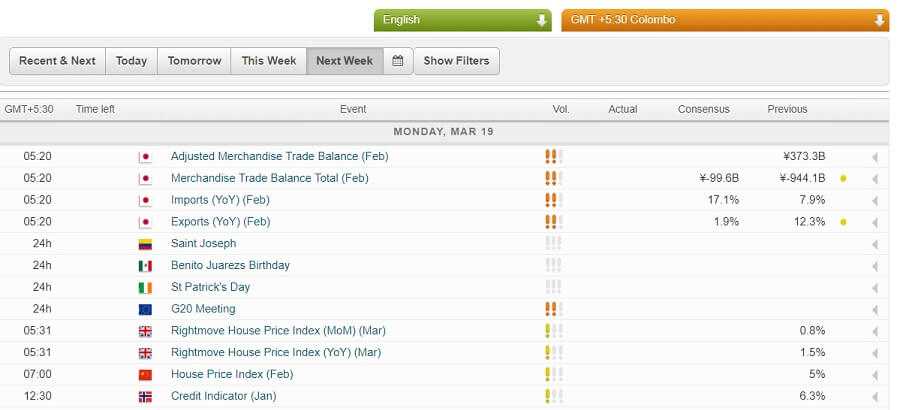
The forex economic calendar is an event-based calendar that traders use to stay updated with current and upcoming financial information. An FX calendar contains data for past and future economic events of different states and can hint the trader about the future volatility expansions of certain currency pairs. Each currency is the representative of social, political, and economic stability of a country.
In addition, changes in the economic indicators of a country a likely to affect the value of the respective currency. Because each forex pair consists of two currencies, each pair illustrates the balance of market sentiment for the two states that represent the currency pair.
How to Use the Forex News Calendar
Traders use the economic events calendar to catch price moves and data releases. If you have a data release, which is better than the forecast, then you’re likely to determine the current pair appreciates versus other notes. Hence, you may consider buying the currency with the better-than-expected data release on the belief that this note will increase as the result of the optimistic economic release. The opposite thought applies if the release is poor than the expectations. In this case, investors say that the data release is “downbeat,” which is likely to cause depreciation of the related currency versus other notes. You may consider selling the currency that is expected to depreciate.
Timing Trades When Using a Fx Events Calendar
Trade execution time is necessary when trading economic news because currencies tend to reach instantly to the data sent. But, other releases are likely to start a long-term impact as well! Take for example the interest data decision in a certain country. Interest rates are used by central banks as the inflation regulator and currency price. No country wants to see its currency very cheap or very expensive. Hence, central banks can decrease or increase the rates in their respective states to suppress or activate spending and growth.
If interest rates are expensive, then loan costs will increase as well. This means that traders will take on fewer loans. This will decrease currency value, inflation, and spending in that state. If interest rates are low, then loans will be cheaper and more pleasing! This will boost currency value, inflation, and spending in the state. Therefore, interest rates have a long-term impact on the currency pair.
Risks Caused by High Impact News/Data Releases
As swing traders, the events marked red are the ones you should be aware of. Whether the data comes out right in line, way below, or way above the market expectations, volatility around the event is common. Since traders know these events result in volatility, which they may not want to be a part of, they cancel their pending orders. This results in a reduction in liquidity right before the market moving event occurs. For there are fewer orders to buy and sell, the price will often swing back and forth before choosing a more sustained direction.
Reducing Your Risks with the Economic Calendar
Before you start trading, check your economic calendar each morning and take note of the times of the major data releases. Under normal market conditions, you need to know what your risk on every trade is. The risk on each trade should be less than 2% of account equity – where risk is the difference of your entry price and stop loss price, multiplied by the position size. Let’s assume you’re trading a stock or other markets with a tight bid at each price level to absorb your orders, your stop loss order will get you out of the trade at the rate you want. When a high impact data release comes out, things change drastically! You deal with a very high chance of slippage, which is when you get the worse price than expected.
Due to its unpredictability, seasoned day traders commonly close out their future positions or forex three to five minutes before high impact data are released. They also avoid taking new trades until after the data has been released. Considering that moment of increased risk is planned and can be easily avoided, it’s best to do so. If you deal with its day-trade options, you could hold your positions through major earnings or data release. Numerous options and schemes are designed for trading these forms of specific events. But, they’re all a bit different than other markets. Once you buy an option, your risk is covered. The premium you paid is the potential loss. If you close out the trade or buy an option you may get slippage, but you can’t lose more than the premium you paid.
The YouTube video below explains how to use Economic Calendar
Trading in the direction of the release is one of the most common news trading plans. The point is to wait for an event and to trade immediately in the path of the announcement. If the event is better than predicted, then you buy the respective currency. If the event is low than expected, you simply sell the currency. Your stop loss order needs to be placed on the other side of your entry point, preferably beyond a recent swing.

One response to “Forex Economic Calendar: What You Need to Know Beforehand”
Impressive! Nice knowing about this. May I know that what are the benefits or other purposes about economic calendar? Thanks in advance!