Let’s be honest: the modern arranged marriage market is no longer just about ladoos, family blessings and awkward living-room teas.
For some people, it has practically become a full-time project management role.
A Pune-based procurement manager, Vikas Lohtia, became an internet sensation after revealing that he had done something wonderfully practical when overwhelmed by arranged marriage prospects:
He put them into a Microsoft Excel spreadsheet.
Yes, arranged marriage had entered the world of Excel.
He used the spreadsheet to keep track of matches, conversations and where things stood. After going through more than 50 prospective matches, he eventually found “the one”, a Gurgaon-based professor he met through Jeevansathi.
It makes for a great viral story. But it also raises a surprisingly serious question:
If we spend months comparing prospective partners, what should we actually be comparing?
Because a spreadsheet can track names and conversations. It cannot decide whom you should marry.
What it can do is force you to think about the questions that may matter long after the wedding photos have disappeared from Instagram.
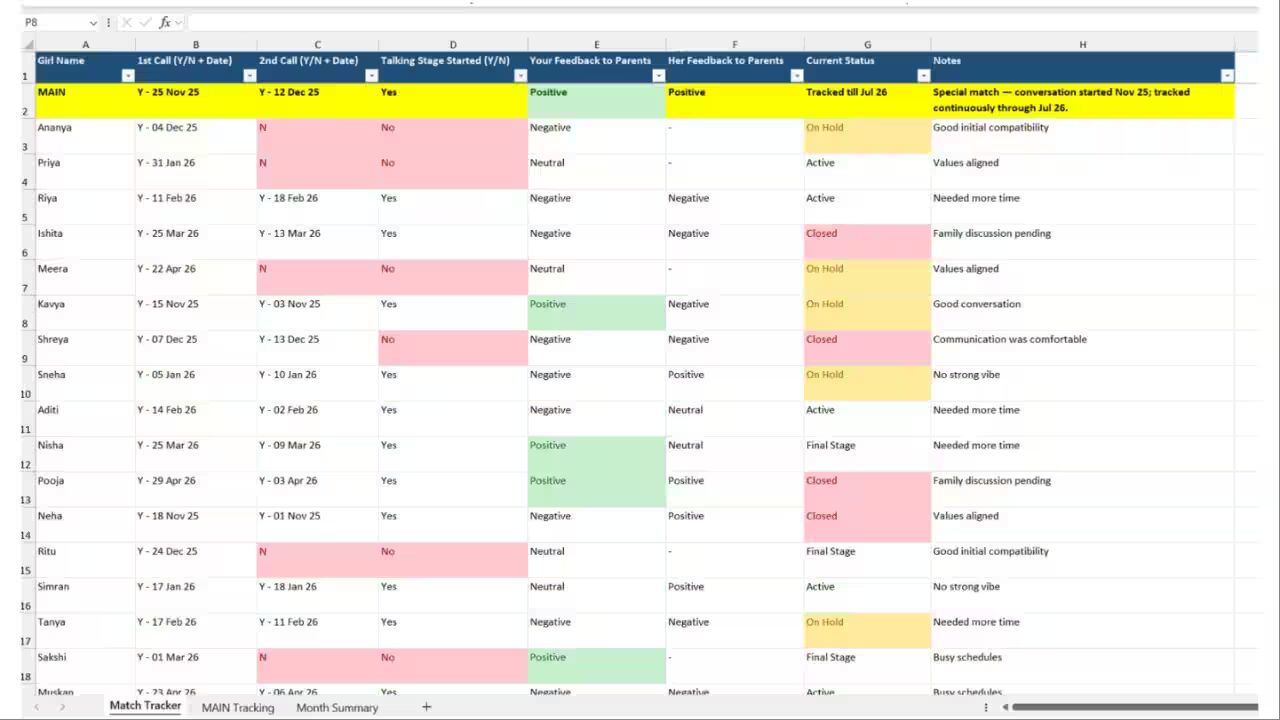
Table of Contents
What Did the Viral Arranged Marriage Spreadsheet Track?
Vikas’s spreadsheet reportedly used practical statuses such as:
- Talking
- On Hold
- Open
- Closed
He also kept notes about conversations, compatibility and family feedback.
In other words, Excel helped him answer a simple operational question:
Where does each conversation currently stand?
That is useful when multiple introductions are happening simultaneously and parents keep asking for updates.
But if you want to create your own Marriage Compatibility Checklist, the spreadsheet can go much further.
Instead of treating people as rows to be ranked, use it as a reminder of the important conversations that two people need to have before making a life-changing decision.
And some of those conversations are uncomfortable.
That is precisely why they matter.
The Marriage Compatibility Checklist: What Really Matters?
1. Conversation and Communication
Chemistry is difficult to reduce to a number, but don’t ignore how the conversation actually feels.
Ask yourself:
- Is conversation natural or constantly forced?
- Can we disagree without becoming disrespectful?
- Do both of us listen?
- Can we discuss uncomfortable subjects?
- Can we say “I disagree” without starting a battle?
- After a misunderstanding, can we actually resolve it?
Your spreadsheet doesn’t need a romantic compatibility score out of 100.
A simple note may be enough:
Good conversation / Comfortable / Needs discussion / Communication mismatch
The purpose isn’t to grade another human being.
It is to remember how the relationship actually felt when emotions and family pressure start clouding your memory.
2. Money and Financial Compatibility
For BeMoneyAware readers, this deserves a column of its own.
Couples frequently discuss salary before marriage. But salary is only one small part of financial compatibility.
Someone earning ₹30 lakh a year but spending ₹32 lakh isn’t necessarily in a stronger financial position than someone earning ₹18 lakh and consistently saving and investing.
Before marriage, discuss:
Income and Career
- What do each of us earn?
- How stable are our careers?
- Do we expect large salary changes?
- Is either person considering entrepreneurship, higher education or a career break?
Debt
Don’t stop at salary.
Discuss:
- Home loans
- Education loans
- Personal loans
- Car loans
- Credit-card debt
- Other major financial commitments
Two people aren’t simply combining incomes. They may also be combining financial obligations.
Spending and Saving
Ask:
What happens to ₹100 that comes into your account?
Does most of it get spent?
Saved?
Invested?
Used to support parents?
There is no universally correct answer. The important question is whether your philosophies are compatible.
Supporting Parents
This can become a major source of conflict if nobody talks about it beforehand.
Discuss:
- Does either partner financially support their parents?
- Is this support likely to increase?
- Are there medical or other family responsibilities?
- What happens if parents eventually need more financial assistance?
Instead of discovering these expectations after marriage, put them on the table early.
Joint or Separate Money?
Talk about whether you expect to have:
- Joint accounts
- Separate accounts
- A combination of both
- Shared household contributions
- Individual discretionary money
Again, there is no single correct model.
Clarity matters more than the model you choose.
3. The Salary Compatibility Test
One interesting part of Vikas’s story involved salary expectations.
During an early conversation with his future partner, he reportedly told her that he earned only half of his actual salary. Her attitude didn’t change because of the lower figure.
It’s an interesting story, but deliberately understating your salary isn’t something you need to copy.
A better test is an honest conversation:
“What kind of lifestyle do you expect us to have?”
That one question can reveal far more than salary alone.
For example:
- How expensive a house do you expect?
- How often do you want to travel?
- Are premium cars important?
- How much should we save?
- Do you want financial independence or an expensive lifestyle today?
- Are you comfortable living below your means to achieve a future financial goal?
The real question isn’t:
“How much do you earn?”
It is:
“What kind of financial life do we want to build together?”
4. Career and Location
Try this question:
“Where do you see your career over the next five years?”
Then go deeper.
Suppose one person receives an excellent opportunity in Bengaluru while the other person’s career is firmly established in Pune.
Who relocates?
Or suppose one partner wants an aggressive corporate career while the other dreams of leaving the corporate world and starting a business.
Neither ambition is wrong.
But ignoring the difference won’t make it disappear.
Discuss:
- Career ambitions
- Relocation
- Overseas opportunities
- Work travel
- Long working hours
- Career breaks
- Entrepreneurship
- Work-life balance
The objective isn’t identical careers.
It is understanding whether two career trajectories can coexist.
5. Parents, In-Laws and Family Boundaries
An Indian marriage rarely joins only two individuals.
It often connects two entire family ecosystems.
So ask the uncomfortable questions early:
“What role do you expect our parents to have in our married life?”
Discuss:
- Living independently vs living with parents
- Frequency of visits
- Caring for ageing parents
- Financial support for parents
- Family involvement in decisions
- Festivals and holidays
- Privacy
- Boundaries with extended family
Loving your parents and having boundaries are not contradictory.
The important green flag is being able to discuss both openly.
6. Household Responsibilities
This conversation sounds trivial until two exhausted people come home from work at 8:30 p.m. and discover that nobody has thought about dinner.
Ask:
“If both of us are working, how will we divide household responsibilities?”
Discuss:
- Cooking
- Cleaning
- Grocery shopping
- Managing bills
- Children
- School responsibilities
- Caring for elderly parents
It doesn’t have to be mathematically 50/50 every day.
Marriage rarely works like that.
But the underlying mindset should be:
“This is our household. How do we manage it together?”
rather than:
“That is your job.”
7. Children and Parenting
This is one area where people shouldn’t simply assume their partner thinks exactly as they do.
Discuss:
- Do we want children?
- When?
- How many?
- What happens if circumstances change?
- How would we divide childcare?
- What are our expectations around education?
- How important are religion and cultural traditions?
- What parenting philosophy do we broadly believe in?
There may not be agreement on every detail today.
But fundamental differences should not remain hidden behind:
“We will figure it out after marriage.”
Some things become considerably harder to “figure out” later.
8. Health and Lifestyle
This isn’t about rejecting someone because of a health condition.
It is about creating enough trust to discuss matters that may affect life together.
A better question is:
“Are there health, lifestyle or caregiving considerations that either of us feels are important to discuss before marriage?”
Also talk about:
- Exercise
- Food habits
- Alcohol
- Smoking
- Sleep
- Stress
- Mental wellness
- Work pressure
- Lifestyle expectations
You don’t have to enjoy the same workout or eat the same breakfast.
But major lifestyle differences are worth understanding beforehand.
9. How Do You Handle Conflict?
Perhaps Excel’s most valuable column cannot be filled in after one meeting.
It requires observation.
What happens when the two of you disagree?
Does the other person:
- Listen?
- Shout?
- Withdraw completely?
- Involve parents immediately?
- Become defensive?
- Apologise?
- Look for a solution?
- Expect to “win” every argument?
A happy marriage doesn’t require zero conflicts.
It requires two people who can navigate conflict without destroying trust.
Green Flags Before Marriage
Instead of judging a person from one answer, look for patterns.
Independent Thinking
They love and respect their family but can make adult decisions independently.
Financial Openness
They can discuss income, expenses, debt and financial responsibilities without unnecessary secrecy.
Career Support
They take your ambitions seriously instead of assuming one career automatically takes priority.
Clarity About Children
They can openly discuss whether they want children and their broad expectations around parenting.
Healthy Family Boundaries
They can balance respect for parents with the independence required by a married couple.
Collaborative Mindset
When discussing bills, chores, parents or children, their instinct is:
“How will we handle this?”
not:
“That’s your responsibility.”
Healthy Communication
They can disagree without disrespect.
Potential Dealbreakers to Discuss Carefully
Not every disagreement is a red flag.
But certain patterns deserve more discussion before proceeding.
Watch for:
Money Secrecy
Major debt, financial commitments or lifestyle expectations consistently being avoided.
Career Control
One person automatically expects the other to relocate, resign or downgrade their career.
Family Decisions Without Boundaries
Every important decision requires parental approval even when it primarily affects the couple.
Fundamental Disagreement About Children
One person definitely wants children while the other definitely doesn’t.
Avoiding Difficult Conversations
Every serious question is dismissed with:
“We’ll see after marriage.”
Unhealthy Conflict Patterns
Repeated silent treatment, personal attacks, manipulation or refusal to discuss problems.
A difference is not automatically a reason to reject someone.
But unresolved fundamental incompatibility deserves attention before marriage, not after it.
What Should Your Marriage Excel Sheet Actually Contain?
If you really want to build a Matrimony Matrix, keep it simple.
| Area | What to Discuss | Possible Tracker Field |
|---|---|---|
| Communication | Conversation, disagreement, openness | Communication |
| Money | Income, savings, debt, spending | Financial Compatibility |
| Career | Ambition, relocation, career breaks | Career Alignment |
| Parents | Living arrangements, support, boundaries | Family Expectations |
| Children | Whether, when, parenting | Family Planning |
| Household | Chores and responsibilities | Domestic Compatibility |
| Lifestyle | Health, travel, habits | Lifestyle Alignment |
| Conflict | How disagreements are handled | Conflict Resolution |
| Future | Where you want to be in 5–10 years | Long-Term Goals |
But here’s the important bit:
Don’t create a total score.
Marriage isn’t a credit score.
A person getting 87/100 does not automatically make them a better life partner than someone getting 82.
Use the spreadsheet as a conversation checklist and memory aid, not a human ranking algorithm.
Does a Love Marriage Need an Excel Sheet Too?
Here is the million-rupee question.
If you didn’t choose the arranged route but fell head-over-heels in love, do you get a free pass from all this?
Is love enough?
Bollywood has spent decades telling us that love conquers everything.
Reality is slightly less cinematic.
Love is the engine; logistics are the track.
Love won’t automatically decide:
- Where you live
- Whether you want children
- How you manage money
- Whose parents need financial support
- Whether someone relocates for a career
- Who handles a crying baby at 2 a.m.
- Whether ₹50,000 should be invested or spent on a holiday
In fact, people in love may need these conversations more because affection makes it easy to say:
“We love each other. We’ll figure it out.”
Hopefully you will.
But figuring some things out before marriage is considerably cheaper, easier and less painful.
The Rose-Tinted Glasses Test
If you’re in a serious relationship, forget Excel for a moment.
Sit together and answer five questions:
1. Money
How do we want to earn, spend, save and invest?
2. Career
What happens when our careers pull us in different directions?
3. Family
What role will our parents have in our married life?
4. Children
Do we want them, and what kind of parents do we hope to become?
5. Conflict
What happens when we strongly disagree?
If you can honestly talk about those five topics, you’re already doing something more important than filling cells in Excel.
Marriage Is Not an Excel Formula
Vikas’s spreadsheet is entertaining because it brings project-management logic into one of life’s most emotional decisions.
But perhaps there is a useful lesson hiding behind the viral story.
You don’t need 20 columns, conditional formatting and a pivot table to find a life partner.
But you do need clarity.
You need conversations about money.
About careers.
About parents.
About children.
About responsibilities.
About health.
About expectations.
And about the kind of life you want to build together.
Because compatibility isn’t about finding someone whose spreadsheet row contains no red cells.
It’s about finding someone with whom you can discuss the red cells honestly.
Excel can organize the search.
It cannot choose your partner.
That decision still belongs to two human beings.
What About You?
Would you ever maintain an Excel sheet for matrimonial matches?
What is the strangest question you’ve been asked during an arranged marriage meeting?
And whether yours is an arranged or love marriage, what is the one question you believe every couple should discuss before saying “yes”?
